> Creative > Films


Ganaraag- melody of the masses hits upon a crucial emotional note within us that generates vibrations powerful enough for both, internal and external cleansing of senses and thoughts. It motivates you to raise your voice against injustice, and also gives you the clarity on the necessity to preserve traditions for the larger good.
National award winning filmmaker Dip Bhuyan puts in an honest effort to weave a tale that intends to draw people’s attention towards a fading tradition of Ojapali and how it binds the characters and influences the various aspects of their lives. But it also emphasizes upon the fact that ‘Art should never be mixed with Politics’.
The film opens with a wide shot of a road that could have any destination-surrounded by wilderness, and also a busy village market functioning parallel on both sides, almost setting the mood for a journey that is long and unknown, but surely involves the common folk.
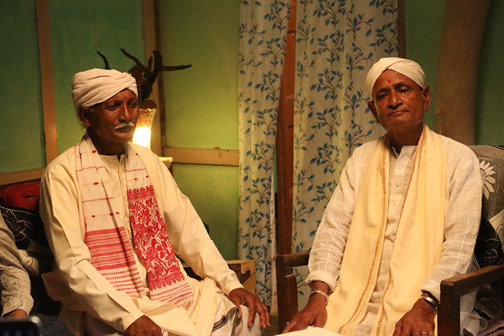
Photo credit : Dip Bhuyan
A villager looking for an Ojapali artist who is selling fresh produce for a living, even at a ripe old age, and his immediate acceptance of an invitation to perform with his team at a religious ceremony, though with the due permission of the Oja, the lead artist, paves the path for a film that genuinely tries to promote the art form as an inseparable element of the local culture.
As we move ahead and explore the lives of the different characters involved in the art form, we realize, how it is on the brink of extinction with minimal patronage. The performers struggle to survive with dignity or remain unsure on how to pass on their talent, skills and legacy to the next generation.
Each frame, be it Gokul Kai convincing Ratan Oja to prepare for the performance, as he weaves a bamboo mat, or the other artists and their day to day chores and concerns of their wives about unmet requirements in the house and the ongoing struggle for survival is established well.
The lights set the mood for both, melancholy and hope simultaneously as the film moves ahead. The props also tell you, how the characters have learnt to find peace with the minimum that life has been offering.
The scene of the first performance during the religious ceremony at a villager’s house, also inserts a moment where the younger lot are engrossed in surfing the mobile phones, indifferent to traditional art forms. The elders, though, fortunately, are responsible enough to sit through.
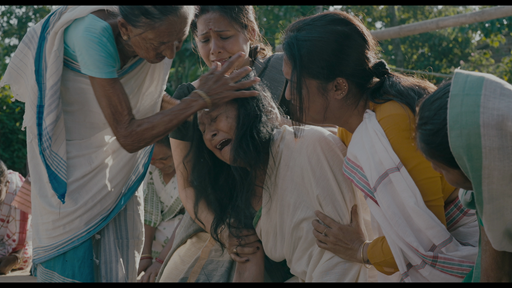
Photo credit : Dip Bhuyan
This is the bitter truth of contemporary times where various art forms are gasping for breath that can be revived only when the masses, of all age groups stand by it and embrace it as their own, and not just a means of survival of few elderly villagers.
Many of the scenes, when the artists perform and the people sit around or dance and sing along are convincing enough to show how, Ojapali or such traditional forms of performing arts, can be used for mass mobilization. The forms even though traditional, are yet flexible enough to meet the requirements of contemporary times, and generate mass awareness on religion, health, family planning or their right to cast the vote to the right candidate.
Ratan Oza says, “Deb debietu amak nukhuwai….aibur gai amar ki labh hobo. Ami Jodi manuhar geet gaboloi pau, bhalei lagibo.” (Mythological tales alone are not going to help us earn a living… It is important that we take up contemporary issues in our compositions and performances to aware the masses)
The zeal, wisdom and open mindedness of the Oja and his team, to participate in the election campaign just because they believe that the masses should not take any wrong decision is remarkable. This sense of responsibility towards their fellow folks, is though exploited by the political party, that though uses them for their campaign, but mostly shy away from paying their dues on time.
The wide frame showing the team, riding on their respective bicycles, always from left to right (the direction of life)… through the muddy path amidst paddy fields and open grazing grounds, the trees standing tall cherishing their selfless efforts, is very appealing and convincing enough to believe how they are ready to embrace any discomfort to keep up with their commitments. Even if it means sleeping outside the house, or in someone else’s courtyard, and also skipping meals if required.
The Ojapali artists work as daily wage earners wherever necessary and try to make ends meet, just to be able to continue with their passion for the form. Their life balances between hope and despair. The filmmaker, in a scene uses the dry branches of a tree to show the hardships they face, while the paddy field Gokul kai walks amidst reflects hope.
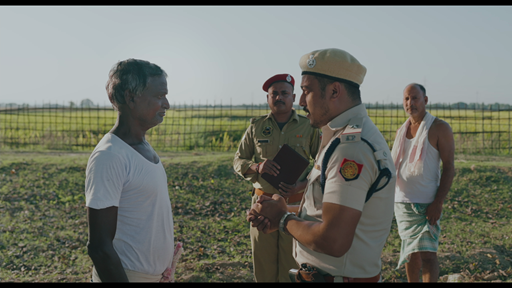
Photo credit - Dip Bhuyan
Every shot is presented with simplicity to reflect the simple ways of their life. The performance of the actors is highly convincing as there is no display of melodrama. Every character is very naturally presented.
The women in the story are equally important. Be it Ratan Oja’s or Gobind Oja’s wife who stand by their spouse’s struggles, or Bina and her lady companion for the campaign, or the team of young and middle aged women who come forward to carry the baton of Ojapali forward defying any social restrictions, to keep good intentions alive.
Bina’s wisdom, sense of responsibility and leadership qualities emerge during every adverse situation, and her submissive self, that gives in to her husband’s verbal abuse initially, also finds courage to fight for her right to decide what she intends to do when, and the best part is, there is no ego or selfish goal, even when she fights her way out of the patriarchal dominance.
The husband, mostly shown with use of low light, to establish his darker side, says to her, “You need to have intelligence in your brain to be able to do social work or participate in any political campaign, you can’t even do the house chores well.”
The lights suddenly go bright with the new self discovery of Bina.
Though these toxic comments pierce her heart, she does not give up, finally finds strength within her plight. Her prayer as she lights the lamp by the home altar, says all about her will to surrender to the universal power and seek his guidance to move ahead as the anchor of the family, a loving mother, a loyal wife and a caring daughter in law, while also a socially responsible citizen.
The mother in law is also more dependent on Bina, than her own son, as her old eyes can judge the caliber of her daughter in law in all fronts.
The characters of Ratan Oja and his wife display ideal love, where each respects the other’s space and is willing to do small little things for each other’s happiness, never deterred by the constraints challenging their survival.
Oja’s decision to sleep out side the house every time he is late for work, his little gesture of carrying some sweets back home for his wife, that was served to him elsewhere, or simply his wife’s efforts to bring to the platter fish and vegetable to nourish him both emotionally and physically. Her teasing him for smiling like a child on seeing fish for dinner, and also serving him some extra rice from her share marks few touching moments in the film as the characters eat their Last Supper together.
The film is also a comment on Democracy and its challenges today in the political context. While Ananda as a candidate is liberal and tells Oja, “You all can vote whomever you want to, but please help me with the campaign through your performances. While the other contestant displays criminal nature of contemporary politics where there is no tolerance for competition and democratic norms.
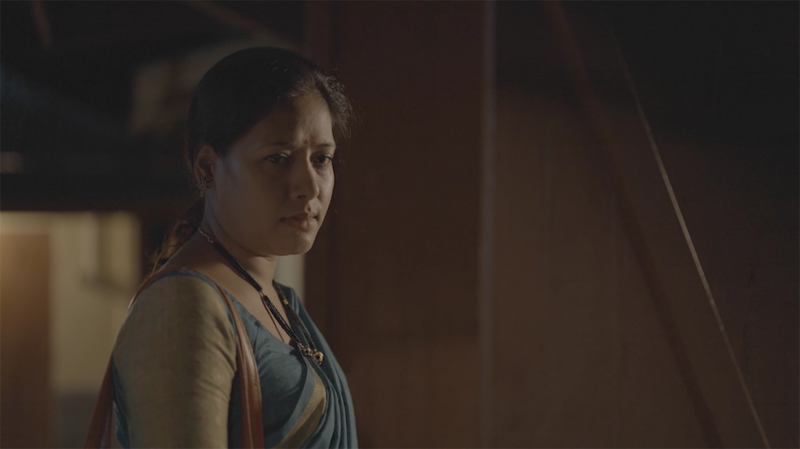 Photo credit : Dip Bhuyan
The attack on Gokul Kai and the murder of Ratan Oja, or the stone pelting on Bina’s house, reflect this intolerance and the insecurities of such criminals who present themselves as people’s representatives.
Ratan Oja’s death remains a mystery, with only the majestic tree, as the witness, the same tree that also remained witness to his hardwork and perseverance to keep Oja Pali alive.
Bina’s strategy to reveal the evil doers, and let truth surface, using combat tactics, though with traditional means gives momentum to the story. The bamboo sprayers and chilli paste does it all. She understands that police complaint and FIRs are of no use. The film throws light on how simple villagers are mislead by law enforcers due to vested interests.
The final scenes might remind the viewer of a scene from Ketan Mehta’s classic Mirch Masala where the women fight injustice suppression in somewhat similar way, though, how Ganaraag concludes has its novelty and uniqueness. The director shares that the idea emerged in his mind after studying some ways of using natural chilli sprays to tackle human elephant conflicts.
The music at every point supports the mood and the message while also arouses curiosity and calm.
The final scene hounours women empowerment and the inner strength that every woman carries. Deodhoni dance by the village women and OjaPali led by Bina and her team mark an important transition of Nari Shakti taking charge, that every society must embrace for larger good and let the melody of the masses echo in the dawn announcing, courage, harmony and compassion.
 Navigations
  Quick Contact
 Subscribe Us
 Quick Mail